Why Mental Health Matters For Moms In Business More Than Most Entrepreneurs Realize
Mar 19, 2026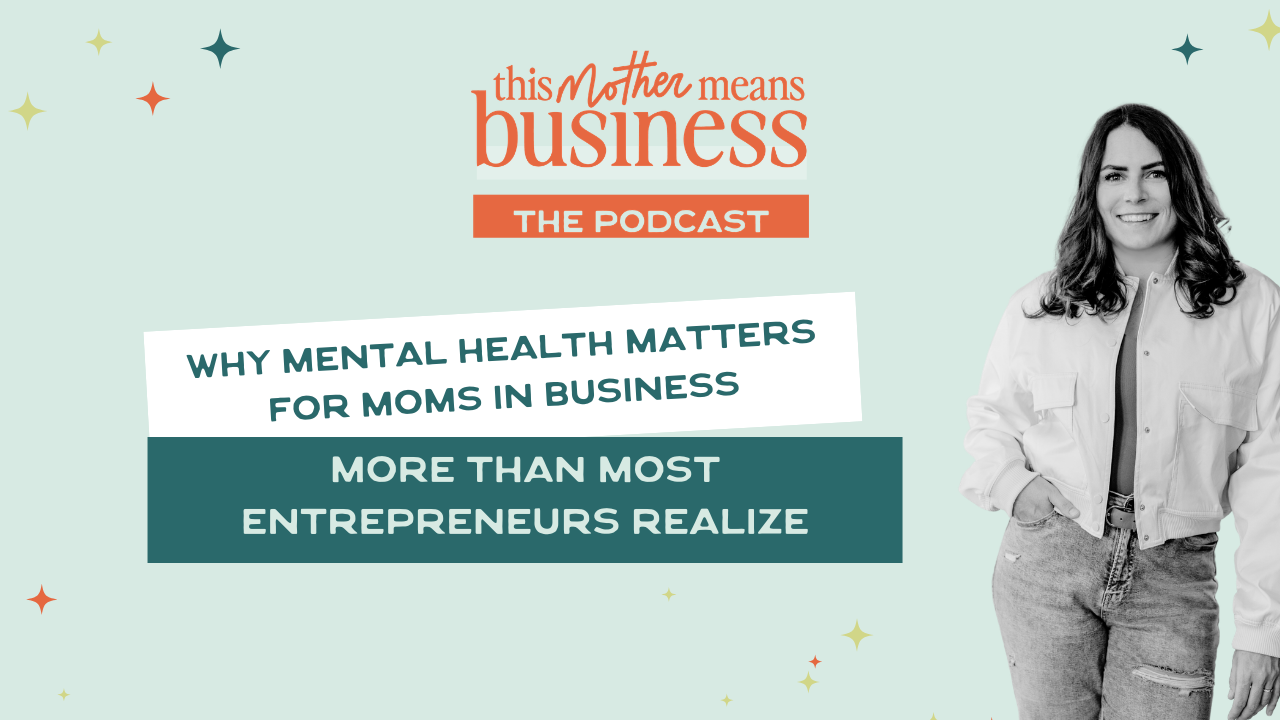
If you’re a business owner, especially a woman carrying both the weight of entrepreneurship and the weight of real life, you’ve probably had moments where business stress feels deeply personal.
Not just “I have a lot to do” stress.
I mean the kind that shows up in your body. The kind that makes visibility feel harder than it should. The kind that turns a simple networking event, podcast interview, or speaking opportunity into something that suddenly feels enormous. The kind that makes you question yourself when, from the outside, everything looks like it’s going just fine.
In this episode of This Mother Means Business, I sat down with Dr. Amanda Tobe, an industrial-organizational psychologist and founder of Amanda Tobe & Associates, to talk about the human side of building a business. We talked about anxiety, public speaking, career pivots, motherhood, identity, fear, and the mental load so many entrepreneurs quietly carry.
What I loved most about this conversation is that Amanda brings both professional expertise and lived experience. She understands workplace psychology, but she also understands what it means to make a major career pivot, build a business around what matters most, and keep showing up through incredibly hard life circumstances.
This conversation felt like an important reminder that mental health is not separate from entrepreneurship. It is part of it. And the more honest we are about that, the more supported and sustainable our growth can become.
What This Episode Reveals About Fear, Visibility, and Building a Business as a Human Being
One of the most powerful parts of this conversation was hearing Amanda break down the fears underneath public speaking anxiety. So many entrepreneurs assume that if they feel nervous about being visible, speaking on stage, recording content, or being interviewed, it must mean they are not cut out for it.
But that is not the truth.
Amanda shared that public speaking anxiety is often rooted in four core fears: fear of negative evaluation, fear of failure, fear of losing control, and fear of having power. That last one especially stood out to me because I think so many women are far more uncomfortable with being seen as an authority than they realise.
And yet visibility is part of business growth.
Whether you are pitching yourself for podcasts, showing up on Instagram stories, speaking at events, or simply telling people what you do with more confidence, there is often an emotional cost attached to that visibility. Not because you are doing it wrong, but because being seen can feel vulnerable.
Fear does not mean you are unqualified
One of the things I wanted listeners to hear in this episode is that fear is normal. It is not a sign that something is wrong with you.
I work with entrepreneurs every day, and I do not know a single one who never experiences fear, doubt, or anxiety. Confidence is not the absence of those things. It is often the willingness to keep going alongside them.
Amanda shared a distinction that I think is so helpful here: task-focused strategies versus emotion-focused strategies. In other words, some of what helps us comes from preparation and practice. But some of what helps us also comes from learning how to work with our inner thoughts, nervous system responses, and distorted beliefs.
That matters because not every visibility issue is a strategy issue. Sometimes it is an emotional one.
The story you tell yourself shapes the experience
One insight Amanda shared that stayed with me is how often people make public speaking about themselves.
Will they like me?
What if I mess up?
What if I forget what I want to say?
What if I look foolish?
These are such human thoughts, but they also keep us trapped in self-protection mode.
Amanda encouraged listeners to shift the question from “How do I perform well?” to “What am I here to do?” That reframing is powerful. It moves the focus from impressing people to serving them.
As a mentor, I see this everywhere. The entrepreneurs who become most grounded in their visibility are usually not the ones trying to be the most polished. They are the ones who get clear on the message they want to leave people with.
Career pivots are often less reckless than they look
Another part of this conversation I loved was hearing Amanda talk about her own pivot.
In her early 30s, while on maternity leave with young children, she began asking herself bigger questions about whether the career she had built was still the one she wanted. That alone is such a relatable experience for so many women. There comes a point where being good at something is no longer enough. You want alignment too.
Amanda spoke so beautifully about allowing herself to explore that question without forcing an outcome. She did not begin with certainty. She began with curiosity.
I think that is such an important point.
So many women think a pivot has to begin with a perfect plan. But more often, it begins with an honest admission that something no longer fits. From there, clarity comes through exploration, not pressure.
She also shared the concept of ikigai — the intersection of what you are good at, what you can be paid for, what the world needs, and what you love. That missing piece of love was what helped her realise she needed something different.
That resonates deeply with me, and I know it will resonate with many listeners too.
Boundaries are not a luxury, they are a business skill
Amanda also shared how she structures her days as a mother of three girls while running a growing practice. She talked about ending client work in time for school pick-up, protecting time with her kids, and learning the difference between working in her business and working on it.
This part of the conversation felt especially important because I think a lot of entrepreneurial mothers are still trying to earn their boundaries. We tell ourselves we will create more spaciousness later, after the next launch, after the next client, after the next revenue milestone.
But later is a moving target.
What I appreciated about Amanda’s perspective is that her boundaries are not built around perfection. They are built around values. She knows what matters to her, and she is making business decisions accordingly.
There is so much wisdom in that.
You can be deeply resourced and still be affected by hard things
Toward the end of the episode, Amanda shared that she was recently diagnosed with breast cancer.
She spoke with incredible honesty about what it has looked like to keep navigating business, motherhood, healing, appointments, uncertainty, and support. And what struck me most was not just her resilience, but her intentionality.
She talked about naming her fears clearly. About not letting vague anxiety take over. About asking better questions. About using community, openness, and support as part of her healing process.
There was something so moving about hearing someone who professionally supports others through fear and transition say so openly that she is not immune to hard things either.
And that matters.
Because I think sometimes we assume that if we just become more skilled, more healed, more self-aware, we will somehow outgrow the emotional realities of entrepreneurship and life. But that is not really how it works. We do not become immune. We become better equipped.
That is a very different thing.
Support is not weakness, it is wisdom
One theme that kept surfacing throughout this episode was support.
Support through therapy.
Support through community.
Support through boundaries.
Support through systems.
Support through asking questions.
Support through letting people care for you.
I think entrepreneurship can sometimes make us feel like everything depends on our ability to hold it all. But the truth is that sustainable growth is usually built with support, not in the absence of it.
That is true in business.
That is true in motherhood.
And it is absolutely true in hard seasons.
What I hope you take from this conversation
More than anything, I hope this episode reminds you that being affected by your business does not mean you are doing business wrong.
Being visible can feel vulnerable.
Growth can stir up fear.
Success can trigger old patterns.
Transitions can bring grief as well as excitement.
And hard life circumstances do not wait for convenient timing.
You are not failing because you feel those things.
You are human.
And sometimes the bravest thing you can do is stop pretending that mental health and entrepreneurship are separate conversations.
This episode is such a meaningful reminder that your mindset matters, your nervous system matters, your boundaries matter, and your support systems matter. Not because they make you more productive, but because they make your business more sustainable and your life more whole.
If this conversation resonated with you, I hope it also gives you permission to get more honest about what you need. Sometimes that looks like asking for help. Sometimes it looks like creating a better boundary. Sometimes it looks like getting curious about a fear instead of letting it run the show.
And sometimes it simply looks like realising that you are not the only one feeling what you are feeling.
That alone can be incredibly healing.

