You don't need to have everything about business figured out. My interview with Tori Wesszer of Fraîche Living
Sep 14, 2026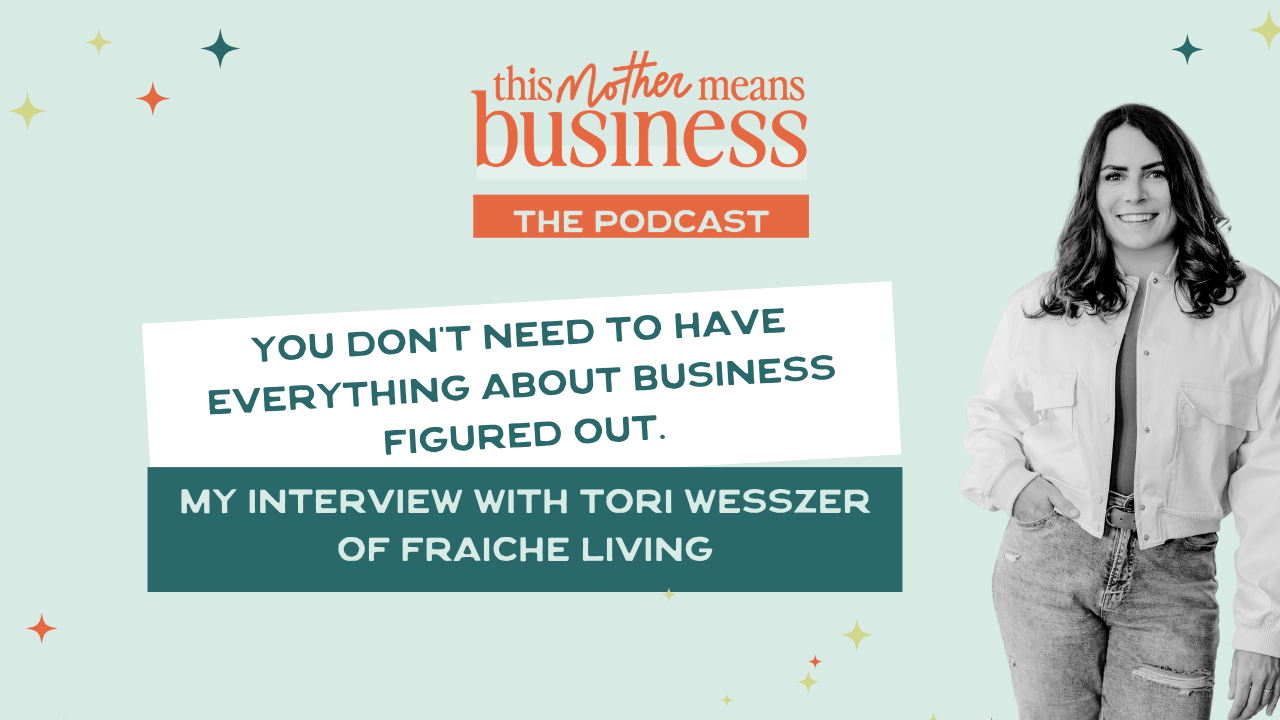
There’s a particular kind of pressure that comes with entrepreneurship—the feeling that you should know where you’re going, how you’re going to get there, and preferably have a beautifully mapped-out five-year plan to prove it.
But what if you don’t?
I recently sat down with Tori Wesszer, founder of Fraîche Living, registered dietitian, cookbook author, creator of Fresh Table, and—as she somewhat accidentally discovered—tech founder.
Tori has built an incredible brand and business, but one of my favourite things about our conversation was how quickly she dismantled the idea that any of it happened overnight—or according to some perfectly executed master plan.
Her story is one of starting before she was ready, building slowly, asking for help, following the opportunities in front of her, and creating solutions to problems she was experiencing in her own life.
And there is so much we can learn from that.
The Business You See Today Started With an Ugly Blog
Tori started blogging in 2014 while still working her corporate job. Her first blog? In her words, it was ugly.
She didn’t have incredible photography skills. She wasn’t particularly tech-savvy. She didn’t really know what she was doing.
She started anyway.
That imperfect beginning eventually became Fraîche Living, but it certainly wasn’t an overnight success. For years, Tori essentially worked two jobs, building her business alongside the security of her corporate career.
She created a very practical benchmark for herself: before leaving her job, she wanted her business to generate the equivalent of her salary for three consecutive months. She needed to see momentum—not one great month that might disappear the next.
I loved this because we hear so much about taking massive leaps in entrepreneurship. Burn the boats! Quit the job! Bet on yourself!
But sometimes betting on yourself looks like building patiently until the numbers tell you it’s time.
As Tori put it, business is a marathon, not a sprint. You keep getting 1% better, keep showing up, and give what you’re building enough time to actually become something.
Sometimes Your Best Business Ideas Come From Your Own Frustration
One of Tori’s biggest focuses today is Fresh Table, a meal-planning platform designed to answer a question that haunts busy women everywhere:
What the heck are we having for dinner?
And this wasn’t a problem Tori identified through some elaborate market research exercise. She was living it.
Here was a registered dietitian and cookbook author who still found herself struggling with the mental load of planning meals for her family.
If she was struggling, she knew other women were too.
That became the foundation for Fresh Table: removing as much friction as possible from feeding yourself and your family. Meals are planned, recipes are tested, grocery lists are created, and users can customize their week based on what works for their household.
Because, as Tori pointed out, cooking often isn’t actually the hardest part.
It’s everything that happens before the cooking.
It’s deciding what to make. Checking what you have. Making the list. Buying the groceries. Remembering to thaw the chicken. Realizing you’re missing one ingredient at 5:15 p.m. when everyone is hungry.
That mental load matters.
And I think there’s a bigger business lesson here too: pay attention to friction.
Where are people getting stuck? What feels unnecessarily difficult? What problem keeps coming up over and over again?
Sometimes the opportunity isn’t creating something completely revolutionary. Sometimes it’s simply making something people already need significantly easier.
You Can Do Anything. You Cannot Do Everything.
Tori is a mom. She runs Fraîche Living. She leads a team. She has Fresh Table. She creates content. She writes cookbooks. She recently launched Fresh Start, a nutrition program designed to help women cut through the overwhelming amount of nutrition information coming at them every day.
So naturally, I asked her the question we always want to ask women who appear to be doing a million things:
How?
Her answer was refreshingly simple.
She gets help.
But that didn’t always come naturally.
Tori grew up watching women simply handle things themselves. If something needed doing, you did it. Asking for help wasn’t necessarily part of the equation.
That mindset followed her into entrepreneurship until she reached the point where doing everything herself simply wasn’t sustainable.
Her first hire terrified her.
Today, she has a small but mighty team and has learned not only to delegate, but to appreciate surrounding herself with people who are better than she is at certain things.
There’s an important distinction there.
Getting support isn’t just about finding someone to take tasks off your plate. It’s also about recognizing that you do not need to be the most talented person at every function inside your business.
In fact, your business gets better when you aren’t.
The Goal Isn’t Perfect Balance
We also talked about the word balance, which Tori admitted she doesn’t particularly love.
I get it.
Balance can sound like another impossible standard we’re supposed to achieve—as though every area of our lives should receive exactly the right amount of attention at exactly the right time.
That’s rarely what real life looks like.
Tori talked candidly about building a business while her children were young, working two jobs, and wondering at times whether she would regret some of the moments she missed.
That is the complicated truth of building something while raising a family.
There are seasons.
There are trade-offs.
There are moments when one part of your life needs more from you than another.
Perhaps instead of chasing perfect balance, the better question is whether we’re putting the right amount of energy into the things that matter most in this season.
Because the math doesn’t need to work perfectly every day. We just want it to keep working when we zoom out.
You Don’t Need to Know Exactly What Comes Next
Toward the end of our conversation, I asked Tori what she sees for Fraîche Living five or ten years from now.
She has big ambitions for Fresh Table and would love to see it become a go-to meal-planning platform across North America. She’s explored ideas like television and continues to grow the lifestyle side of Fraîche Living.
But beyond that?
She doesn’t entirely know.
And she’s okay with that.
I think more entrepreneurs need permission to say that.
You can have ambition without knowing exactly where it leads. You can have a vision without controlling every detail of how it unfolds.
Some of the best things we build are things we couldn’t have predicted.
Tori never set out to own a software company. I certainly didn’t set out to build This Mother Means Business into everything it has become.
Entrepreneurship is full of these happy accidents.
The opportunities you can’t put on a vision board because you don’t even know they exist yet.
Increase Your Surface Area for Luck
Tori left us with an idea I haven’t been able to stop thinking about:
Increase your surface area for luck.
Get into the room.
Meet people.
Have conversations.
Put yourself in places where opportunities have a chance to find you.
We spend so much of our lives behind screens now—especially as online business owners. But real connection still matters. The person you meet tomorrow could introduce you to an opportunity you don’t know exists today.
You can’t manufacture every opportunity that will come your way.
But you can make yourself easier for opportunity to find.
So maybe you don’t need to know exactly what your business looks like five years from now.
Maybe you need to start before you’re ready.
Keep getting 1% better.
Ask for help sooner.
Pay attention to the problems worth solving.
And then get out from behind the screen every once in a while and increase your surface area for luck.
You never know what might happen next.