I Gave Myself Three Months to Fix My Business or Close It Down. Here’s What I Did.
Oct 15, 2026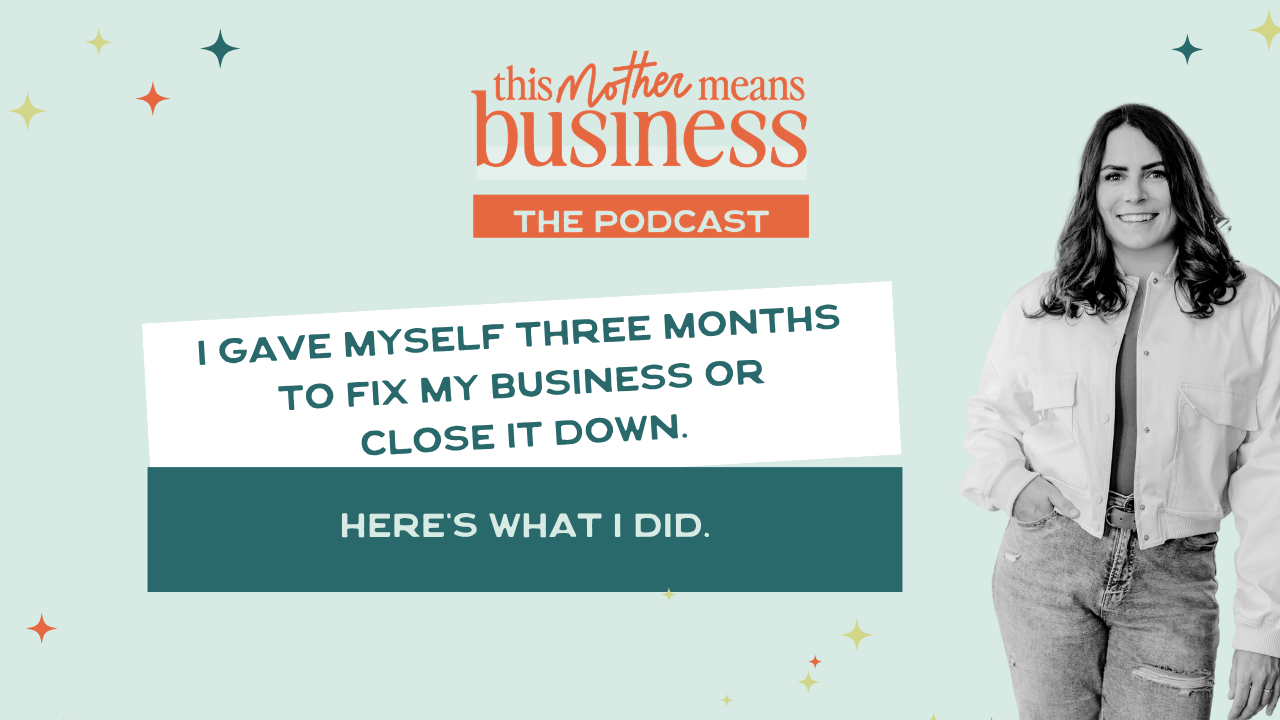
I’ve been an entrepreneur for 11 years, and if there’s one thing I know for sure, it’s that business growth is not a straight line. We love to talk about growth like it should happen neatly: you make more money this year than last year, your audience gets bigger, your offers get better, your team grows, and everything continues moving up and to the right.
But sometimes life happens. And in 2024, life happened to me in a pretty spectacular way when I fell off my horse and broke my leg. At the time, I knew it was going to be bad. What I didn’t realize was how much that accident was going to expose about the business I had spent nearly a decade building. As it turns out, breaking your leg isn’t particularly good for business when your business relies heavily on your ability to show up for it.
By September 2024, I was sitting in my office stressed about money, stressed about the business, and honestly unsure about what came next. Then my husband knocked on my office door and asked if we could talk. I knew exactly what the conversation was going to be.
Give Me Three Months
After years of running a multi-six-figure business, 2024 was shaping up to be my worst financial year as an entrepreneur. I ultimately made about $100,000 less than I had the year before, and while my husband wasn’t pressuring me, we had a life to pay for. We needed to figure out what the plan was and whether that plan included me finding a job.
I told him I needed three months. Give me until the end of the year to figure this out, and while I’m doing it, please don’t ask me about it. I was already putting so much pressure on myself that having someone else questioning what I was doing was only going to make it harder. He agreed, and more than two years later, he hasn’t asked me again.
Recently, someone who has been in my community for a long time messaged me and commented on how much my business has evolved since I broke my leg. It made me stop and really think about what happened between that conversation in my office and where the business is today.
Because a lot has happened. We’ve hosted three major events. I’ve secured six figures in sponsorship value from corporate partners. I’ve closed a mastermind and reopened it, started a membership and closed it, and rebuilt my private coaching offers. There has been plenty of experimenting, but underneath all of it was a very intentional shift in how I was building my business.
When I really break it down, there were four things that changed everything.
1. I Got Support
The first thing I did was hire a business coach. And listen, this is not me saying, “Your business is struggling? Go spend a bunch of money on coaching.” I didn’t hire a coach because I lacked business strategy. I know strategy. What I needed at that point was support.
I was still physically recovering. My routines had fallen apart. I wasn’t eating properly, I wasn’t working out, I was stressed about money and, if I’m being completely transparent, I felt like a failure. I needed someone outside of my own brain who could help me carry some of the mental load.
Joining a 12-month mastermind gave me accountability and someone who could ask questions, poke holes in my thinking and help me look at both my business and my life differently. It also put me around women who were building businesses and thinking in ways I wanted to think. At the time, I had incredible clients, but I didn’t have the strong peer network that I have now, and I didn’t realize how much I needed that.
That experience reminded me of something I’ll carry with me through every future season of business: I do not need to be the person who figures all of this out by myself.
2. I Went Back to Business Basics
This might be the least sexy piece of business advice I’ll ever give you, but when things weren’t working, I stopped looking for something new and started looking at what was already true. I looked at my numbers, where my leads were coming from, my close rate, which content was actually working, which visibility strategies were producing something and which partnerships were paying off.
Essentially, I wanted to understand: when I do X, does it actually produce Y?
Then I looked at the things I had stopped doing. Consistent lead generation. Consistent selling. Working on my positioning. Taking the basic actions I already knew were required to grow the business. I had spent months recovering from a broken leg, so of course I hadn’t been operating at my normal capacity. I’m not interested in criticizing that version of myself for doing what she needed to do to get through it.
But when I had the capacity again, I had to start doing the work again. I stopped chasing shiny objects and went back to the strategies I already knew worked.
Business does not have to be as complicated as we make it. Sometimes profitable business growth comes from doing the boring, foundational things consistently.
3. I Reconsidered the Architecture of My Business
Breaking my leg forced me to confront something I probably should have recognized earlier: I had built myself a job. It was a successful job, I had a team, and I wasn’t necessarily trading hours for dollars in the traditional sense, but the business still depended heavily on my energy and my ability to show up.
That wasn’t what I ultimately wanted to build. I want a business with legacy. I want to create something that could eventually exist beyond me, something I could potentially leave to my children or exit from one day. For that to happen, I couldn’t continue being the foundation of the entire business.
So I started looking differently at revenue. Could the podcast generate revenue? Could we create physical products? What about events? What else could exist underneath the This Mother Means Business brand beyond people simply paying for access to me?
That thinking eventually led me to introduce larger live events as another revenue stream. Our 2025 event wasn’t particularly profitable, but it drove people into our paid community, which made it valuable in a different way. Our 2026 event was profitable, and now we’re already planning 2027.
There’s an important distinction here, though: more revenue streams does not mean more offers.
I see business owners get themselves into trouble with this all the time. They decide they need to make more money, so they create another offer. Then another. Then another. Suddenly, one human is trying to sell eight different things to eight different people.
That is not what I mean by diversifying revenue. I started asking how we could create additional ways for the business to generate money, not how I could personally deliver more services.
In fact, on the offer side of my business, I did the opposite. I simplified.
4. I Prioritized Monthly Recurring Revenue
I do not want to run a business where I wake up every month and start at zero. I don’t want to constantly chase $300 here and $400 there. I want predictable monthly recurring revenue, so I changed the structure of my coaching offers and eliminated my short-term private coaching options in favour of a 12-month minimum commitment.
Yes, recurring revenue is part of the business strategy behind that decision, but it’s also better for my clients. I know my best work doesn’t happen in 12 weeks. Business growth doesn’t happen in a vacuum, and my clients are making significant strategic decisions, building companies, launching physical products, writing books and doing things that require time.
The clients who have worked with me for six months, a year or longer consistently have the strongest results. Moving to longer commitments allowed me to create more stability in my own business while also structuring my offers around the way I know I can best serve my clients.
That is the kind of business strategy I’m interested in: decisions that make the business stronger without making the client experience worse.
There Was No Magic Thing
This might be the most important part of the story. There was no magic manifestation that took me from sitting in my office asking my husband for three months to running a multi-six-figure business again.
I took the required actions. I asked for what I wanted. I became consistent again. I got support, looked at the numbers, simplified what needed to be simplified, built new revenue streams and stopped expecting myself to be the entire foundation of the business.
Will I have another difficult season in business? Of course. I’ve been doing this for 11 years, so I know better than to think there won’t be another dip, unexpected life event or moment when something I’ve built stops working. But now I know where I’ll start when it happens.
I’ll get support instead of assuming I need to solve everything myself. I’ll go back to the basics instead of looking for the newest strategy. I’ll look at the architecture of the business and make sure our revenue streams still make sense. And I’ll continue prioritizing predictable, recurring revenue wherever it makes sense to do so.
The Business Is Growing Again. Now I Have a Different Job.
The last two years have been significant, and I’m incredibly proud of what I’ve built and rebuilt. But after a year with a lot of sprinting and a lot of growth, my focus for the rest of this year is different: I need to take better care of myself.
Because rebuilding a business that doesn’t rely entirely on me isn’t particularly useful if I turn around and run myself into the ground anyway. Maybe that’s the next chapter of this story.
For now, whether your business is having its best year ever or you’re sitting in your own version of that September 2024 moment wondering how you’re going to make this work, remember that a hard season does not have to be the end of the story. Get the help you need, look at what’s actually working, come back to the foundations and take the required actions.
Then go run your business like the CEO you are.